

2023 Hurricane Season
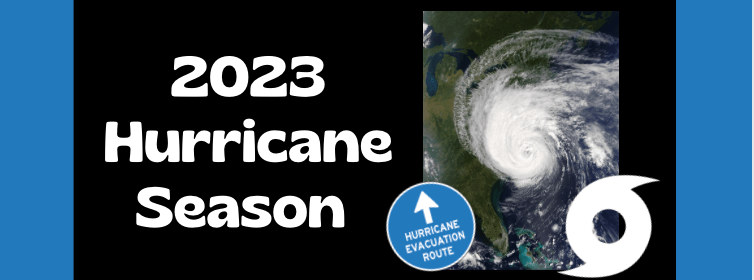
Hurricane season usually runs from June 1 to November 30 each year in the Northern Hemisphere. Although we are only half way through the season, experts are already predicting an “above normal” season. Experts are expecting fourteen to twenty-one storms, of which, six to eleven will be hurricanes, and two to five will be major hurricanes. So far, 2023 has seen sixteen storms, one of which did not occur during hurricane season.
Storms are categorized in a variety of ways. Tropical depressions are cyclones with winds of thirty-eight miles per hour or less. Tropical storms are cyclones with winds of thirty-eight to seventy-three miles per hour. Hurricanes are categorized using a five level scale. A category one hurricane has winds of seventy-four to ninety-five miles per hour. A category two hurricane has winds of ninety-six to 110 miles per hour. A category three hurricane has winds of 111 to 129 miles per hour. A category four hurricane has winds of 130 to 156 miles per hour. A category five hurricane has winds of 157 miles per hour or more. Categories three, four, and five are considered major hurricanes.
Unnamed Subtropical Storm (January 16-17, 2023)
This subtropical storm was not named as a tropical storm when it originated. The National Hurricane Center reevaluated the storm in July and determined it did qualify as a tropical storm. The storm began off the eastern coast of the United States and headed north through the Gulf Stream. After making a brief landfall–the intersection of the surface center of the storm with the coastline–in Nova Scotia, Canada, causing no serious damage, the storm died off.
Tropical Storm Arlene (June 1-3, 2023)
Arlene developed over the northeastern Gulf of Mexico and made an unusual southward turn before it dwindled. The storm never made landfall, and there were no reports of damage caused by the storm. The top wind speed was thirty-eight miles per hour with gusts of up to fifty-two miles per hour.
Tropical Storm Bret (June 19-24, 2023)
Bret began off the northeast of Venezuela and headed west. Heavy rains and storm surge were reported among the Caribbean islands of Dominica, St. Lucia, Barbados, and Martinique, but the storm did not directly pass over the islands, so it did not officially make landfall. The storm reached winds of seventy miles per hour. After passing the islands, Bret dissipated over the Central Caribbean sea.
Tropical Storm Cindy (June 22-26, 2023)
Cindy was a short-lived tropical storm that began in the central Atlantic caused by a large wave off the west coast of Africa. It did not make landfall and did not cause any significant damage. The storm had wind speeds of fifty-eight miles per hour. Cindy and Bret both existed in the Atlantic at the same time, the first time this has occurred in the month of June since 1968.
Hurricane Don (July 10-24, 2023)
Don began as a tropical storm off the coast of Bermuda and headed northeast. It was officially declared a hurricane on July 22 by the National Hurricane Center while it was off the eastern coast of Nova Scotia, becoming the first hurricane of 2023. Its hurricane status only lasted one day as it rapidly slowed into a tropical storm and then depression the next day.
Tropical Storm Emily (August 20-22, 2023)
Emily began off the coast of the Cabo Verde Islands, West of Senegal, and began moving northwest. The storm moved at twelve miles per hour with winds of up to fifty miles per hour. The storm never made landfall and quickly dissipated over the mid-Atlantic Ocean.
Hurricane Franklin (August 20-September 9, 2023)
Hurricane Franklin was the first major hurricane of the 2023 season, reaching the title of a category four. The storm began Southwest of Bermuda and headed north at nine miles per hour. Wind speeds reached up to fifteen miles per hour. Franklin never made landfall. It took an eastward turn as it headed north and slowed to a category one. Eventually, Franklin absorbed Tropical Storm José before dissipating.
Tropical Storm Gert (September 1-4, 2023)
Gert was first detected in mid-August but did not officially become a tropical storm until early September. It began off the northern coast of Bermuda. The storm moved east at fifteen miles per hour. Gert never made landfall as it moved around Post-tropical Cyclone Idalia. It dissipated over the mid-Atlantic Ocean.
Tropical Storm Harold (August 21-24, 2023)
Harold developed over the central Gulf of Mexico and headed west. Harold was the first storm of the hurricane season to make landfall. It passed over southeast Texas and northeast Mexico. With winds of up to sixty miles per hour, several power outages were reported. Most outages occurred in Brooks County, Texas, one hundred miles south of Corpus Christi. No injuries or major damage was reported.
Hurricane Idalia (August 27- September 1, 2023)
Idalia began southeast of Cancun, Mexico. The storm reached a Category Three hurricane with winds of 125 miles per hour. Idalia headed east and made landfall near Tampa, Florida. Passing over Florida, southeast Georgia, eastern South Carolina, and southeast North Carolina. The storm dissipated in the mid-Atlantic. All of the affected states saw thousands, if not more, power outages. One casualty was reported in Valdosta, Georgia from a fallen tree. Preliminary estimates say Florida agriculture may have lost up to $371 million from the heavy rains and flooding.
Tropical Storm José (August 29-September 1, 2023)
José developed in the North Atlantic. It moved northwest with maximum winds of fifty miles per hour. It was absorbed by Hurricane Franklin. Hurricanes and tropical storms can absorb into one another when two storms’s paths collide. In these cases, the stronger of the two storms prevails.
Tropical Storm Katia (September 1-4, 2023)
Katia developed about one thousand miles off the coast of the Cabo Verde Islands. It headed northwest moving at five miles per hour. It eventually began moving faster at thirteen miles per hour. Katia had maximum sustained winds of forty miles per hour. It never made landfall and no damage was reported.
Hurricane Lee (September 5-17, 2023)
Lee developed off the west coast of Africa and moved northwest. Lee was the first category five hurricane of the 2023 season. It moved west of Bermuda, pounding the islands with heavy rain, wind, and surf. After weakening to a category one, it made landfall in New England and Nova Scotia. 92,000 customers in New England lost power, the majority in Maine, and another 161,000 in Nova Scotia. Florida and other areas of the southeast US were not directly hit, but they did see some rough waves and rain. Two casualties were reported; one from a fallen tree in Maine and another from a rip current in Florida.
Hurricane Margot (September 7-17, 2023)
Margot was a category one hurricane that developed near the Cabo Verde Islands and headed northwest. Margot never made landfall. It traveled through the Eastern Atlantic, looped around itself, and dissipated near Azores, Portuguese islands one thousand miles west from the mainland.
Hurricane Nigel (September 15-22, 2023)
At its peak, Hurricane Nigel was a category two. Nigel developed in the mid-Atlantic, west of Bermuda. It moved north west towards the United Kingdom (UK). Nigel was unique because it is known as an annular hurricane, meaning it developed a very large eye, making it look like a donut on the radar. Only four percent of hurricanes are annular. The storm never made landfall, but did cause heavy rains and flooding in parts of the UK.
Tropical Storm Ophelia (September 21-24, 2023)
Ophelia developed off the southeastern North Carolina coast and headed north. Ophelia made landfall in North Carolina’s Outer Banks. North Carolina’s coastal towns saw heavy rain, winds, and storm surges of up to four feet. Virginia, Maryland, Washington DC, Pennsylvania, and New York were also affected. Over 53,000 people in North Carolina and Virginia lost power. Wind speeds reached seventy miles per hour while the storm crossed through North Carolina. No fatalities or major injuries have been reported.
Tropical Storm Philippe (September 23-29, 2023)
Phillipe developed off the east coast of the Lesser Antilles islands and headed northwest at fifteen miles per hour. The storm had maximum winds of forty-five miles per hour. It did not make landfall and did not cause any significantly poor weather or damage. It eventually dissipated in the Caribbean Sea.
2023 has already seen seventeen storms, six of which were hurricanes, and three were major hurricanes. This season has already begun to set records; 2023 is tied with 2005, having the third most Atlantic named storms before September 23. Ranked number one and two is 2020 (twenty-three named storms) and 2021 (eighteen named storms), respectively, according to Colorado State University’s researchers. Many experts are crediting the heavily active storm season to El Niño. El Niño is a climate pattern that constitutes abnormally high ocean temperatures. Warm oceans can cause more frequent storms. Climate change is also believed to cause stronger hurricanes, by contributing to warming waters. Research shows that the most damaging hurricanes hitting the US are three times more frequent than they were one hundred years ago. Moreover, the number of major Atlantic hurricanes has doubled since 1980. As there are still two months left in the hurricane season, many more storms are expected.
 Peak Student Media