

North Dakota State: Ascending to FBS
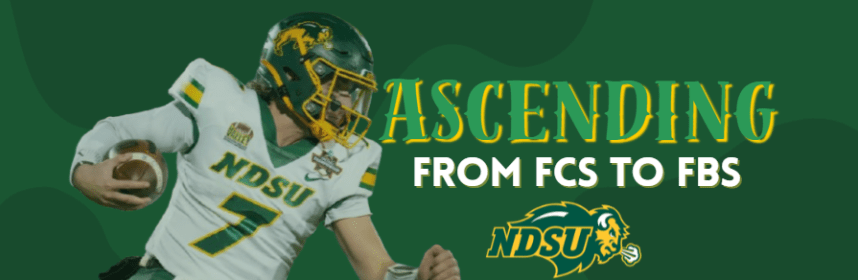
North Dakota State University’s move from FCS to FBS is one of the largest headlines in college
sports right now.
While schools like North Carolina’s very own Appalachian State or James Madison University
made a splash during their arrivals in 2014 and 2022, respectively, NDSU has established a
monumental reign over the FCS in its fourteen-year dynasty. In that period, they amassed 10
National Championships (winning all 10 appearances); a five-peat (woah); NFL first-round stars
Carson Wentz and Trey Lance; and a nearly 2:1 Win/Loss ratio against FBS teams, including an
infamous upset over #13 ranked Iowa State in 2016. However, FCS dominance does not equal
success at the next level.
North Dakota State University joins a competitive Mountain West Conference (MWC) as a result
of the absence of Boise State, who is now included in the PAC-12. This left a power vacuum in
the conference, and with their competitive nature, they may be the team to fill that gap. While it
is likely that UNLV, who has made an appearance in all three of the last championship games,
will fill this void, NDSU will still have a chance to throw its hat in the ring for a championship
bid. Competing in a conference that recently lost its dominant dynasty is a boon to the Bison, but
opportunity does not erase the vast amount of issues that they will face outside of the Mountain
West and general competitiveness of the FBS. If anything, that becomes the least of their issues.
The much larger issue here becomes logistics. One primary concern about the team’s rise to FBS
is the academy itself, for a litany of reasons. Before discussions about their joining began, size
and costs made the move seem implausible, despite the team’s success. Analysts such as Kirk
Herbstreit were under the impression that the city of Fargo simply could not sustain an FBS
football team, all the while NDSU trades unprecedented dominance at their level for FBS
mediocrity.
Likewise, their location proves to be one of these obstacles. The closest school to Fargo, North
Dakota, is Colorado State, spanning an 800-mile distance. The farthest MWC school from Fargo
is the University of Hawaii, with its continental distance of 3,500 miles! This creates heavy
travel fees, which would be difficult for any university to maintain, let alone one in the Big Sky.
This financial burden is on top of the already existing monetary issues for the school, and is just
one of many logistical obstacles. Furthermore, this is uncharted territory for the academic
organization, as they were well above average when it came to FCS operating expenses.
And if you thought that was it, moving up isn’t free either, and in more ways than one. The
combined fee for the MWC and FBS sets them back 17 million dollars, compared to their $30
million ‘athletic operational expenses’. While it is possible that if the university had enough
success to earn a Bowl Game, they’d get a sizable monetary reward, an FBS rule prohibits them
from doing so for a two-year waiting period. Yikes.
With their sour situation, NDSU would look to the MWC conference to keep them afloat, and for
the city of Fargo to break open the wallet. This exact scenario played through the minds of
legislators when discussing how to utilize their Legacy Fund, an important part of North
Dakota’s state economy. 68% of voters polled about how to use the money agreed that it should
be focused on domestic investment, rather than out-of-state or foreign markets, including its
public universities like NDSU and University of ND. This forms a possible precedent for the city
and state to work to fund the college.
Even then, this move to the FBS level is still colossal, and may even set a precedent for other
FCS schools to make the jump, such as NDSU’s rivals like South Dakota State or the University
of North Dakota. Roughly a week ago, Sacramento State made the jump along with NDSU,
raising many questions about its new conference in the MAC. Many college football fans were
outraged, believing that the MAC was one of if not the only college football conferences that
honored regional ties, before becoming a coast-to-coast conference and adding a California
college to a traditionally midwest conference.
Despite all the financial hurdles and the new level of competitiveness in the FBS, nobody can
truly know what North Dakota State’s FBS tenure will look like. We’ll just have to see, but in
today’s world of college football, you either soar, or you sink, and the Bison need to be prepared
for both.
 Peak Student Media