

The Debt Ceiling Crisis, Explained Simply
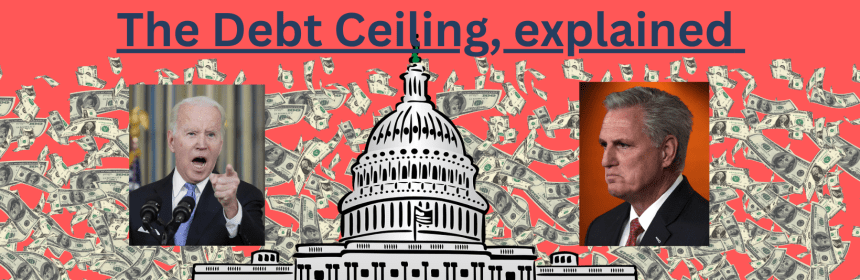
All developed nations have a national debt. The national debt increases when a country spends more money than it collects in taxes. The United States has had a national debt since the founding of the country. It grew in 1790 when it was agreed that the federal government would assume the states’ debts thanks to Alexander Hamilton’s famous compromise with Anti-Federalists. The debt has only been entirely paid off once in 1835 during the Andrew Jackson Administration. However, this would not last. As the nation grew, so did the debt. The Civil War, the New Deal, and the World Wars all caused the debt to skyrocket. Today, the debt is nearly $32 trillion dollars.
Many economists agree that the national debt isn’t a concern as long as the US keeps it at manageable levels and makes its payments on time. In most countries, there is no restriction on how much debt the nation can have. In the US, however, there is. The so-called “debt ceiling” is the artificial limit on how much debt the US treasury is allowed to take on. This limit is set by Congress and can only be raised by Congress (with the signature of the President). If the US were to reach the ceiling, the US could risk default. This would have catastrophic consequences on the global economy as people would lose trust in US markets, and it would more than likely trigger a major economic recession. The current limit is $31.4 trillion.
The US has actually already reached this figure in January, but for the past five months, the Treasury has been using “extraordinary measures” to continue paying obligations without accruing more debt. Secretary of the Treasury Janet Yellen has stated that Congress has until June 1st to raise the debt ceiling without triggering a default.
The debt ceiling has been raised nearly one hundred times since its inception in 1917. Throughout most of history, the debt ceiling was raised without controversy in a bipartisan manner. It wasn’t until recently that there began to be “fights” over the debt ceiling. The most famous case was in 2011 when the Republican-controlled Congress used the debt ceiling as leverage to demand spending cuts from the Obama Administration. Under immense pressure, Obama and moderate Republicans came up with the “Grand Bargain”. The compromise would’ve made historic cuts to Social Security and Medicare. This compromise outraged Obama’s liberal base. But it never happened because the tea party wing of the Republican party thought the compromise didn’t go far enough. The fight spooked markets on Wall Street leading to the most unstable period since the 2008 recession. It wasn’t until just a few days before the deadline that President Obama and Congressional Republicans could come to an agreement on the debt ceiling.
Congress almost always waits until the last minute to raise the debt ceiling. And when they do, it’s only by a tiny bit. This is done on purpose to sew the seeds for another debt ceiling fight in the near future. And so, in 2013, another debt ceiling fight occurred where Republicans demanded the repeal of the Affordable Care Act (Obamacare).
It’s important to understand that choosing to raise the debt ceiling does not authorize new spending. Raising the debt ceiling simply allows the government to go into debt to pay for spending that Congress has already authorized. Imagine if your teacher told you to write a five-page paper, but they only gave you three pages to write on. In order to meet the obligations of the assignment, you would need to borrow paper from a friend. But your teacher makes a class rule that prohibits you from borrowing. That is effectively what the debt ceiling does.
Debt ceiling fights usually occur during times of divided government. With the White House and Senate being controlled by Democrats and the House of Representatives being controlled by Republicans, many political analysts were predicting a fight a week after election day. This time House Republicans are demanding the elimination of pandemic aid, major cuts to discretionary spending, and work requirements for Medicaid and SNAP (Food Stamps). The total savings add up to around $130 billion.
“If you gave your child a credit card and they kept hitting the limit, you wouldn’t just raise their credit limit—you’d sit down and help them figure out where they could cut back on spending,” Speaker McCarthy said on Twitter. In order to get his spending cuts, McCarthy will have to work with President Biden, who is very adamant about not cutting anything. Biden points out how Republicans voted to raise the debt ceiling numerous times under Trump and without cuts.
Biden and McCarthy have met several times to negotiate on the debt ceiling with no agreement yet in place. As June 1st approaches, both sides may be willing to make concessions. At the end of the day, both sides want the same thing: the debt ceiling raised. Democrats and Republicans have gone through this fight several times and it always ends with the debt ceiling being lifted, for at least a year or two. But even the act of waiting until the last minute can harm US’s credit rating and spike interest rates. Legislative procrastination is not healthy for the American economy. With just a week before the deadline, Democrats and Republicans are running out of time.
 Peak Student Media